Friday, July 27, 2012

Still in Jerusalem

The Garden Tomb
In Jerusalem you can go here, the Garden Tomb, where, it is believed, Joseph of Arimathea placed the Lord's body. Not far from here is, it is believed, Golgotha, where Jesus was crucified.

Waiting to enter the Church of the Holy Sepulchre

This ornately decorated area inside the church contains the Holy Sepulchre. People wait for hours to get in.

You can also go to the Church of the Holy Sepulchre in Jerusalem. Since the 4th Century AD pilgrims have come here. The place is claimed sacred--and the actual place of Christ's crucifixion and burial--by Greek Orthodox, Oriental (Eastern) Orthodox, and Catholics.

Not all the people you see in this picture are tourists, you know. Many are devout--believers who count this spot as the climax of their pilgrimage.

No Anglicans or other Protestant groups have a "presence" here. Perhaps they believe the Garden Tomb is
the actual site. But that does not forbid those folks from coming here to see this place, of course.

There is much to see here, above and below ground level. Way below ground we were shown a spot where it looked like three crosses could have been anchored into the ground. Now, that may be confusing because we speak of the crosses being on Calvary's hill. But remember the tel concept.

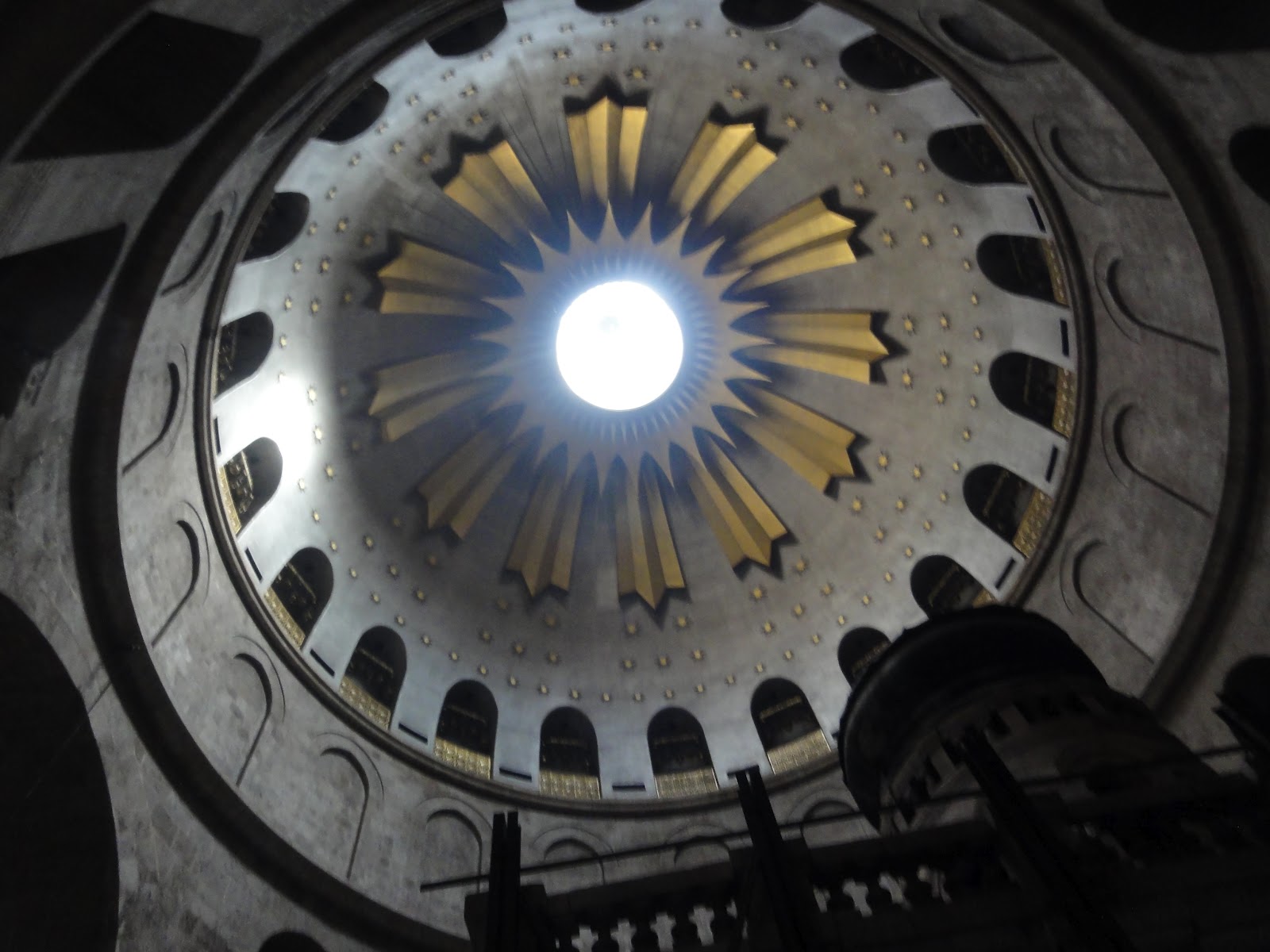
Inside the church. Not sure why I took this picture. Seems I just liked the light in that spot.

From inside the church.


Also inside, down a level or two. I believe this is the Greek Orthodox "presence."
And what do you think?

Friday, July 20, 2012

Old Jerusalem's Western Wall

Yes, of course, we went to the western wall, or The Western Wall. You can't go to Jerusalem and skip the western wall. It's the Wailing Wall, a sacred site for Jews, because it is part of the wall that surrounds the Temple Mount. For centuries Jews from the world over have made pilgrimage to the wall and there have prayed and lingered to pray again.

You might guess that there is a section of the wall designated for women. They cannot stand near the men. The men of orthodox Jewry are not allowed to look at--or on or whatever the right word is--women.

As I indicated many weeks ago, the Temple Mount is a sacred place for Jews and Muslims. And conflicts have arisen over the wall. Muslims fear it is part of a Jewish reclaiming of the entire temple mount. And so on and so forth. Religion can be a great divider. Should I say that? Of course I should. Everyone knows it anyway.

Jewish sentiments.

When we talk about the Temple Mount, we have to bring up Herod. Remember Herod, the Great? The murderer of many, including his own wife; the tyrant; and the rebuilder of Solomon's Temple. Actually, he did begin the rebuilding in about 19 BCE but probably did not finish it. This wall is part of that rebuilding era.

Anyway, we went there, and I was glad, because it has long been a point of interest for me. And yet I did not write a prayer on a slip of paper to stick into one of many cracks in the wall.

This is it. Spectators can go up to the wall, although it doesn't look like it here.

I turned around and took a picture.


My pants are long enough and my posture could be better. Or perhaps I should say, "What a cute white-haired woman." The canopy-covered passageway leads to the wall. It's for the non-orthodox people, like me. See also the corner where the western wall meets a "new" wall.

Here you can see the places to put your prayers. You can also see a newer wall built on top of the older one. It's the way of Israel.
I was in Israel eight days (another five days in Egypt and Jordan), and my blogs have stretched over many weeks. I'd apologize, but I don't feel like it. Life has intruded, and, besides, I figure people can only tolerate one or two posts about this trip in a week. Again I will say this was the trip of my lifetime. Certainly not the only place I've been but likely the most interesting to me.

Monday, July 16, 2012

Sometimes some people do hard things.

Hezekiah's Tunnel is now a tourist attraction in Israel, but it didn't start that way. Its purpose was to divert the water from Gihon Spring to a) keep the attacking Assyrians from cutting off Israel's water supply; and b) to ensure that the Assyrians did not get that water for themselves.

The digging of the tunnel was close to miraculous--through solid rock, of course, far below the city. Two teams of men dug and finally met to complete the tunnel. One third of a mile.

I do not have pictures of the tunnel. I didn't go. But just let me say this: it is not lighted, not wide or high, not straight or easy to get through, and once you're in it, you cannot turn back. It was made for water to flow through, not people.

I have seen it, though, on You Tube. You can see it, too. Google Hezekiah's Tunnel. It's a fascinating story. And the narrated tour through the tunnel is worth thousands of my words.

I do have pictures of Ann before she traveled down to the tunnel and walked through it. By the way, a) it still has knee-high water in it, and we're talking about--what?--2800 years ago; and b) as the man said on You Tube, if you're claustrophobic, this is not the place for you.

Ann is very claustrophobic, so her walk through the tunnel--20 plus minutes--was remarkable and a high point for her. I can only tell so much about this. Ann will have to tell the rest.

The pictures:


Christel, Tina, Ann with their flashlights, before going down, way down, to the tunnel.

Ann comes up the final steps after traversing the tunnel.

No explanation needed.
My post script: I love Ann. I am proud of her.

Friday, July 13, 2012

Banias Spring

Remember the Jordan River?
The River Jordan, near where Christ was baptized.
Up north, near Tel Dan, this is the Jordan.
Jordan River. This is the way I wanted it to look.
The Jordan is fed by three sources, one of them at Banias Spring. Banias comes from Paneas, for the god Pan. The place was an ancient Greco-Roman city before we read of it as Caesarea Philippi in the New Testament.
Banias Spring, one of the sources of the Jordan. Brian and Ann Johnson are in the picture, too.

Banias Spring, Caesarea Philippi

It's a lovely spot. The Brett Johnson family relaxes by the water.

Water used to gush out of the cave. Now it's not a gush but a stream.

Matthew 16 (and Mark 8) tells of Christ's visit to Caesarea Philippi with the twelve. This is where he asks them who other people say he is. They answer. He then asks who they say he is. Peter bears testimony that Christ is the son of God. Then Christ says, among other things, "Blessed art thou Simon [Peter]" and later that he will give Peter the keys of the kingdom.

This is an important time for these men. Christ is preparing them to carry off the kingdom. They don't quite get the picture yet. I say it because when He tells them all he must go to Jerusalem and he will be killed, Peter can't accept it.

"Then Peter took him, and began to rebuke him, saying, Be it far from thee, Lord; this shall not be unto thee. (Mattew 16:22)
"But he turned, and said unto Peter, Get thee behind me, Satan; thou art an offense unto me; for thou savourest not the things that be of God, but those that be of men." (16:23)

Striking contrast.

Caesarea Philippi is at the base of Mount Hermon, which is believed to be the mount of transfiguration. You can read Matthew 17 about the transfiguration. You will note that Peter was there, of course, with the Lord.


Sunday, July 1, 2012

Yep, still in Israel

Brian's photo of the burning truck.

We were winding down the hill in our bus, came around a curve and saw this, a stunning sight. The road ahead closed because of it. We waited 15, maybe 20 minutes, then took another way.

Of course, many of us wanted to de-bus and get closer. Too bad.

Thursday, June 28, 2012

Tel Dan

Some restoration has been done at Tel Dan. Walls rebuilt, I suppose. But it is a tel, built upon ruins of other cities.

The City of Dan was the northernmost city in the kingdom of Israel, which was the northern kingdom anyway. Dan was one of the 12 tribes, remember. In 1 Kings 11 (and other chapters) we can read about Jeroboam, who led the revolt against Judah and the family of David, achieving separation of the kingdoms. Ten tribes in the north, two in the south.

And Jeroboam became king of the northern kingdom. Duh.

But Jeroboam wasn't a true follower of Jehovah, although the golden calves he built for the people to worship--one in Dan--were, he said, representations of Jehovah. He also started worship of wooden images. (Like a log could bring salvation.)

I have a few pictures of Tel Dan, most at the restored city gate, a place of much socialization and city business. The governor of the city would sit on a throne at the gate and see people, conduct business, hear complaints, etc.

Walls at Tel Dan. And a guy I didn't really want in the picture.

A sculpted mural depicting typical activities at the city gate.


The throne at the gate.


And there she is.


From a hill in Dan, I looked across at Lebanon. Things are close over there, nothing like driving all day just to cross Montana or Texas.

Lebanon
Coming down from Tel Dan, Ann helped her mother down the cobblestones. It's just because I wore the wrong shoes.
Thanks to Kathy for this picture, although there is only one thing I like less than a picture of me from behind. Right. It's a picture of me from in front.

Sunday, June 24, 2012

The old becomes new ish

A tel is, to quote our friend Abraham, "town upon town upon town upon town." If time or natural disaster or war destroyed a city, the people who remained simply rebuilt upon the ruins. I mean, why waste the rubble? Use it. Use whatever foundations remain and rebuild. It's what they did.

Remember the synagogue at Capernaum? And, when you go to Israel, take a look at the walls in the old city. Newer built upon older.

Archeologists are all over Israel. Digging. Here we are at Beit Lehi (by the way, beit means house), an archeological dig. We have been down.

Underground in the olive press at Beit Lehi


The columbarium (dovecote) at Beit Lehi. Underground.
And we have been up.
Ann at the church at Beit Lehi, or what they have found of it. 

The church is not underground. So, what do you suppose is under it?

Mosaic, one of many, at the Beit Lehi church.

But a tel could also be a mound or hill, under which lie the ruins of who knows how many cities. Which means if you like to dig, you could be happy for many years. Well, no doubt you'd want to find something.

Pablo. He's an archeologist from Argentina.

Here is our friend Pablo at Beit Lehi, telling us to look around at the hills, then telling us that there are ruins beneath all, that's ALL, of those hills. He knows. He's been here for seven years, has advanced degrees in archeology from U of Buenos Aires. That pretty much makes him an authority.

Lots of people take pictures of flowers. I don't. But this time I did. They were right at my feet as I listened to Pablo.

Some of the hills Pablo spoke about.

Next post, we go to Tel Dan. The name lets us know the place was built upon an older city, or two.

Remember, I'm not going in order. Do you care?